Wood lathe spindle taper explained: It’s a precise fit, essential for securely holding chucks and accessories on your lathe for safe and accurate turning. Understanding it ensures your tools stay put and your projects turn out smoothly.
Hey there, woodworkers and workshop enthusiasts! Daniel Bates here from Lathe Hub. Ever looked at your wood lathe’s spindle and wondered about that cone-shaped bit at the end? That’s the spindle taper, and it’s a really important part of how your lathe works. Getting it right means your chucks and faceplates attach securely, letting you turn with confidence. If it’s not, things can get wobbly, and that’s no fun – or safe! Don’t worry, though. We’re going to break down exactly what this taper is, why it matters, and how to recognize it. Stick around, and you’ll be a spindle taper pro in no time!
What Exactly is a Wood Lathe Spindle Taper?

At its heart, a wood lathe spindle taper is a standardized, conical (cone-shaped) surface on the end of your lathe’s spindle. Its primary job is to provide a precise and self-holding fit for workholding devices like chucks, faceplates, and spur drives. When you tighten a chuck onto a taper, the cone shape forces the chuck and the spindle together, creating a very strong and accurate connection. This is crucial because it ensures your workpiece spins true and doesn’t come loose during operation, which could be very dangerous.
Think of it like a well-made plug fitting snugly into a socket. The taper angle is key to this secure fit. Different machines and manufacturers might use slightly different taper standards, but the principle is the same: a reliable way to mount your turning accessories.
Why Does Spindle Taper Matter So Much?

Understanding the spindle taper is fundamental for several reasons, especially for anyone new to woodturning:
- Safety First: The most critical reason. A loose chuck or accessory rotating at high speeds is a serious hazard. A proper taper fit prevents this by creating immense holding pressure.
- Accuracy and Runout: A precise taper ensures your chuck and workpiece are centered correctly. This minimizes “runout” – wobbling – which leads to smoother turning and better results.
- Accessory Compatibility: Knowing your spindle taper allows you to purchase the correct chucks and accessories that will fit your lathe. Buying the wrong type means it won’t mount properly, or worse, it might mount insecurely.
- Ease of Use: While initially intimidating, once you understand your taper, mounting and dismounting accessories becomes a straightforward process.
- Tool Longevity: A secure fit reduces stress on both the spindle and the accessory, contributing to a longer lifespan for your lathe components.
If you’ve ever struggled to get a chuck to sit perfectly or felt it wasn’t quite locked down, the spindle taper is likely where the answer lies.
Common Spindle Taper Standards Explained
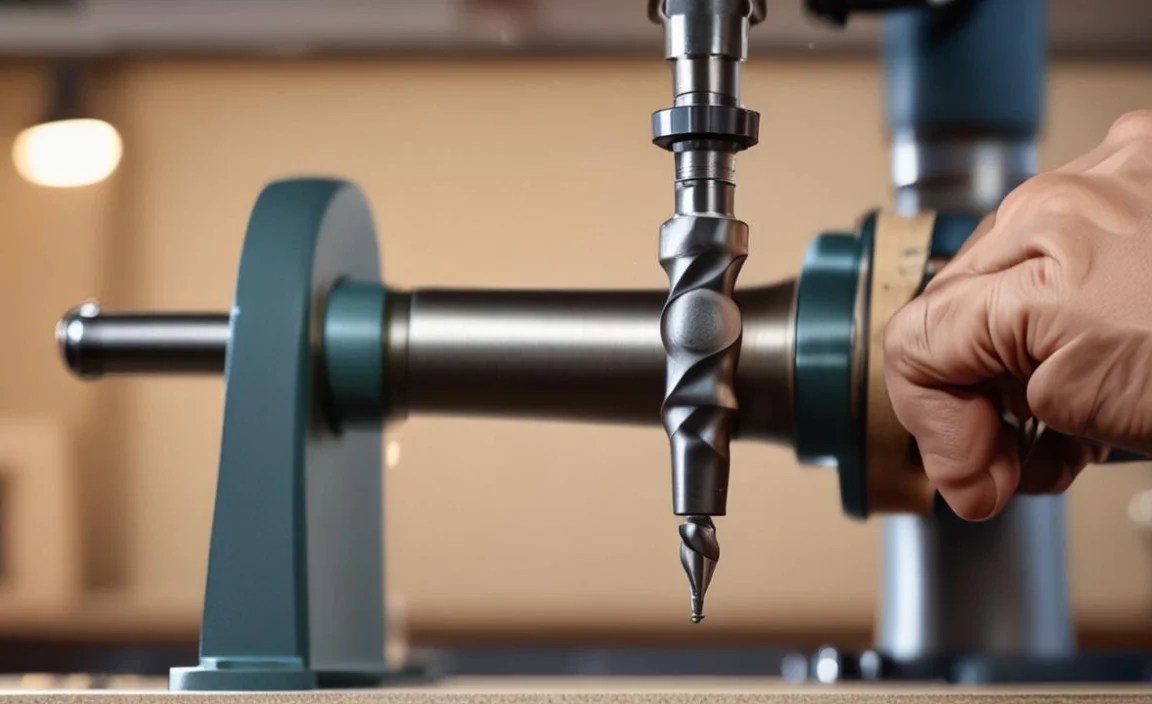
The world of wood lathes (and metal lathes, for that matter) uses standardized tapers to ensure interchangeability and proper fit. For wood lathes, the most common standards you’ll encounter are:
Morse Tapers (MT)
Morse tapers are incredibly common across many types of machine tools, including wood lathes. They are known for their self-holding capability, meaning they lock themselves in place with their own weight and friction, though tightening is still usually involved for absolute security.
Morse tapers come in various sizes, indicated by numbers. For wood lathes, you’ll most frequently see:
- #1 Morse Taper (MT1): Found on smaller, lighter-duty lathes, often used for pen turning or small spindle work.
- #2 Morse Taper (MT2): The most common size for intermediate and many full-sized wood lathes. It offers a good balance of holding power and availability of accessories.
- #3 Morse Taper (MT3): Used on larger, heavier-duty machines capable of handling bigger bowls and longer spindle work.
The taper itself is a specific angle. For standard Morse tapers, the angle is approximately 1.5 degrees per side, or about 3 degrees included angle. This angle is critical; it’s just shallow enough to allow the taper to slide in but steep enough to create significant friction and locking force when engaged.
Jacobs Tapers (JT)
Jacobs tapers are primarily found on drill chucks. You might encounter a Jacobs taper if you have a drill chuck mounted directly to your lathe spindle or on an arbor that then fits into a Morse taper. The taper angle is different from Morse, designed specifically for holding drill chucks.
The numbering system for Jacobs tapers (e.g., JT3, JT6) refers to the dimensions of the taper and the chuck it’s designed to fit.
Acme Threads and Flanges
While not a “taper” in the conical sense, many wood lathes use a threaded spindle nose with a flange for mounting chucks. This is a different system where the chuck screws onto the spindle. The flange provides a flat surface for the chuck to register against. Common thread sizes include 1″ x 8 TPI (Threads Per Inch) or 1-1/4″ x 8 TPI, especially on larger lathes. Some smaller lathes might use specialized thread sizes.
Important Note: It’s crucial to distinguish between a tapered spindle nose and a threaded spindle nose. While an accessory designed for a tapered spindle won’t fit a threaded one, and vice-versa, some chucks are designed with a “thread reduction” that allows them to be adapted to different spindle thread sizes. However, there are also spindle nose adapters that can change a threaded spindle to a Morse taper, or vice versa, expanding your accessory options.
How to Identify Your Lathe’s Spindle Taper

Figuring out what taper your lathe uses is essential before buying any accessories. Here’s how you can do it:
1. Consult Your Lathe’s Manual
This is always the easiest and most reliable method. Your lathe’s manufacturer will specify the spindle thread size and/or taper size in the owner’s manual. If you don’t have a physical copy, search online for your lathe’s model number, followed by “manual” or “specifications.”
2. Check the Spindle Nose Directly
Look at the very end of your lathe’s spindle.
- Threaded Spindle: If you see threads, it’s a threaded spindle. You’ll need to measure the diameter and count the threads per inch (TPI). For example, 1″ x 8 TPI means the diameter is 1 inch and there are 8 threads per inch. You can use a ruler or calipers to measure the diameter and a thread gauge or even just a ruler to count the threads over a specific length (e.g., count threads over 1 inch).
- Tapered Spindle: If the end is cone-shaped without threads, it’s likely a Morse taper. Look for any markings or part numbers directly on the spindle or any adapters.
3. Measure the Taper (If Applicable)
If you suspect a Morse taper, you can often identify the size by measuring its diameter at the spindle face (the part closest to the headstock).
- MT1: Typically around 0.702 inches (17.83 mm) at the large end.
- MT2: Typically around 0.938 inches (23.81 mm) at the large end.
- MT3: Typically around 1.245 inches (31.62 mm) at the large end.
You can use calipers for this. Remember that accessories also have a Morse taper, and they should match your spindle’s taper size for a secure fit.
4. Look for Adapters/Arbors
Sometimes, a lathe has an adapter or arbor installed on the spindle. This adapter gives the spindle a different taper or thread size. You’ll need to identify the adapter first, then the spindle. For example, you might have a threaded spindle with an adapter that creates an MT2 taper. In this case, you would buy accessories for MT2.
5. Search Online Forums and Communities
Woodworking forums and online groups are excellent resources. Post a picture of your lathe’s spindle end and ask for help identifying the taper. Many experienced woodturners are happy to share their knowledge.
Understanding Taper Angles and Fit

The magic of a taper lies in its specific angle. The most common standards have well-defined angles:
- Morse Taper: Standard Morse tapers have a taper rate of 0.960 inches per foot, which translates to an angle of about 1.5 degrees on each side of the centerline (a 3-degree included angle). This precise angle is what provides the self-holding action.
- Brown & Sharpe Tapers (BST): Sometimes seen on older or specialized equipment, these have a steeper angle of about 0.5 inches per foot (approximately 0.57 degrees per side).
- Jacobs Tapers: These vary but are designed to securely grip drill chucks.
What does the angle mean for you?
- Secure Grip: The shallow angle allows significant friction and wedging force when the taper is inserted. When you tighten the drawbar or collar on a chuck, it pulls the taper deeper, increasing this force.
- Precise Alignment: A correctly machined taper ensures that the accessory is perfectly aligned with the spindle’s axis, minimizing wobble.
- Self-Removal (Sometimes): While they hold securely, enough force can also be applied to dislodge them, especially if they are clean and well-lubricated. For Morse tapers especially, a sharp rap with a dowel or rubber mallet on the back of an arbor or tool holder is often enough to break the taper’s hold.
Many manufacturers use a standardized taper design for compatibility across different brands. For example, an MT2 accessory should fit an MT2 spindle on any lathe, regardless of the manufacturer, provided it’s made to standard specifications. You can find detailed specifications on taper standards from organizations like the American Bearing Manufacturers Association (ABMA) or by looking up ISO or ANSI standards for machine tool tapers.
Common Wood Lathe Taper Adapters and Reducers

What if your lathe has a different spindle nose size or type than the accessories you want to use? This is where adapters and reducers come in handy. They are essentially sleeves or threaded components that allow you to change the taper or thread connection.
Spindle Thread Adapters
These are typically bushings that screw onto your existing spindle threads, allowing you to mount accessories with a different thread size. For example, if you have a 1″ x 8 TPI spindle, you might use an adapter to allow you to mount a chuck designed for 1-1/4″ x 8 TPI.
Taper Adapters and Reducers
These are common for converting spindle types:
- Threaded Spindle to Morse Taper: This is a very popular adapter. It has internal threads that match your spindle nose (e.g., 1″ x 8 TPI) and an external Morse taper (e.g., MT2) on the other end. This effectively gives your lathe a Morse taper spindle.
- Morse Taper to Morse Taper Reducer: Less common for chuck mounting, but useful for connecting tool holders. For example, an MT3 to MT2 reducer lets you use MT2 tools in an MT3 spindle.
- Morse Taper to Drill Chuck Adapter: These often have a male Morse taper on one end to fit your spindle and a female Jacobs taper on the other to accept a drill chuck.
These adapters are invaluable for expanding your accessory options. When buying an adapter, always ensure it’s for the correct direction of thread (left-hand threads are rare but exist) and the correct taper sizes.
Table: Common Spindle Taper Sizes and Features

Here’s a quick reference chart for common spindle types you’ll encounter on wood lathes:
| Spindle Type | Description | Common Accessories | Pros | Cons |
|---|---|---|---|---|
| Threaded Spindle (e.g., 1″x8 TPI, 1-1/4″x8 TPI) | A spindle nose with external threads. Accessories screw onto it. Often includes a flange for registration. | Chucks with matching threads, faceplates, drive centers. | Very secure when tightened, wide range of thread sizes available, easy to understand. | Requires specific thread size matching or adapters. |
| Morse Taper (MT1, MT2, MT3) | A conical surface on the spindle nose that allows accessories to be pushed or pulled on for a self-holding fit. | Chucks with MT receivers, faceplates, spur drives, live centers, drill chuck arbors. | Self-holding, excellent for concentricity, widely standardized. | Can be difficult to remove if stuck, requires specific taper size matching. |
| Jacobs Taper (JT) | A specific taper used primarily for mounting drill chucks directly or via an adapter. | Drill chucks. | Secure grip for drill chucks. | Limited to drill chuck applications unless used with adapters. |
How To Mount and Dismount Accessories Correctly
Proper mounting and dismounting are crucial for both safety and the longevity of your equipment. Here’s a general guide:
Mounting a Chuck with a Taper (Morse Taper Example)
- Cleanliness is Key: Ensure both the spindle taper and the inside of the chuck’s taper receiver are perfectly clean. Any dust, debris, or old grease can prevent a tight fit. Use a clean cloth and possibly a solvent like acetone (use sparingly and with ventilation).
- Align the Taper: Gently insert the chuck’s taper into the spindle’s taper. It should slide in a good portion of the way with minimal effort if the sizes match.
- Tighten (if applicable): If your chuck has a drawbar or collar that passes through it and into the spindle, tighten this securely according to the manufacturer’s instructions. For direct Morse tapers without a drawbar system, the chuck relies on friction and the wedging action.
- Cam Lock or Set Screws: Some chucks or accessories have cam locks or set screws that engage with a groove on the spindle or an adapter. Ensure these are locked.
- Confirm Fit: Give the chuck a firm wiggle. It should feel completely solid and shouldn’t move independently of the spindle. Check for any visible gap between the chuck and the spindle shoulder.
Mounting a Chuck with a Threaded Spindle
- Clean Threads: Clean both the spindle threads and the internal threads of the chuck.
- Start Threading: Carefully align the chuck with the spindle and begin threading it on by hand, turning it in the correct direction (usually counter-clockwise to tighten on a standard wood lathe spindle when viewed from the headstock end, but always double-check your specific lathe for its rotation direction). It should thread in smoothly. If it binds, back it off and try again to avoid cross-threading.
- Tighten Against Flange: Continue threading until the chuck’s face or mounting flange is snug against the spindle’s shoulder or flange.
- Locking Mechanism: Most threaded chucks have a locking pin or screw. Engage this mechanism to prevent the chuck from unscrewing during operation.
- Confirm Fit: Wiggle the chuck. It should be locked down tightly and show no play.
Dismounting Accessories
For Tapered Mounts (Morse Taper):
- Unlock: Release any drawbar, collar, cam lock, or set screws.
- Break the Taper: This is the tricky part. Tapers can bind tightly.
- Dowel Method: The most common and safest is to use a wooden dowel or a piece of hardwood placed against the back of the chuck or accessory’s receiver. Strike the dowel sharply with a mallet. It may take a few firm blows.
- Wedge Method: For very stubborn tapers, you might gently tap a thin wedge (made of wood or plastic, never metal against metal) into the gap between the spindle and the accessory, working your way around.
- Never Pry: Avoid prying the chuck off with a lever as this can damage the spindle or the chuck.
- Clean Up: Once removed, clean the taper surfaces thoroughly.
