Wood lathe spindle thread sizes are crucial for securely mounting faceplates, chucks, and other accessories. This guide clarifies common thread dimensions so you can confidently select and use the right ones for your projects, ensuring safe and stable operation on your wood lathe.
Ever tried attaching a new chuck to your wood lathe only to find it doesn’t quite fit? You’re not alone. Many beginners find that “wood lathe spindle thread sizes” can be a bit of a mystery. It’s a common stumbling block that can halt your creative flow. But don’t worry! Understanding these threads is simpler than it seems, and once you know the basics, you’ll be attaching accessories like a pro. This guide will demystify wood lathe spindle threads, showing you exactly what you need to know to keep your projects spinning safely and securely. We’ll break down the common sizes, how to identify them, and what to look out for.
Understanding Wood Lathe Spindle Thread Sizes

Your wood lathe’s spindle is like its anchor, and the threads on the end are what connect your workholding devices to it. These threads allow you to screw on crucial accessories like faceplates, drive centers, and, most importantly, chucks. A secure connection here isn’t just about convenience; it’s absolutely vital for safety. A loose accessory can wobble, vibrate, or even detach during operation, leading to damaged work, a damaged lathe, or a dangerous situation for the operator. Getting the right thread size means your tools will mount firmly, allowing for smooth, predictable turning.
The good news is that most wood lathes stick to a few standard sizes, especially for chucks. However, there are also older or specialized lathes that might use different threads. This guide is designed to help you identify what you have and what you need, whether you’re buying your first chuck or looking to make sure your existing accessories are compatible. We’ll cover the most common imperial sizes used in North America and the UK, as well as briefly touch on metric possibilities.
Why Thread Size Matters: Safety First!
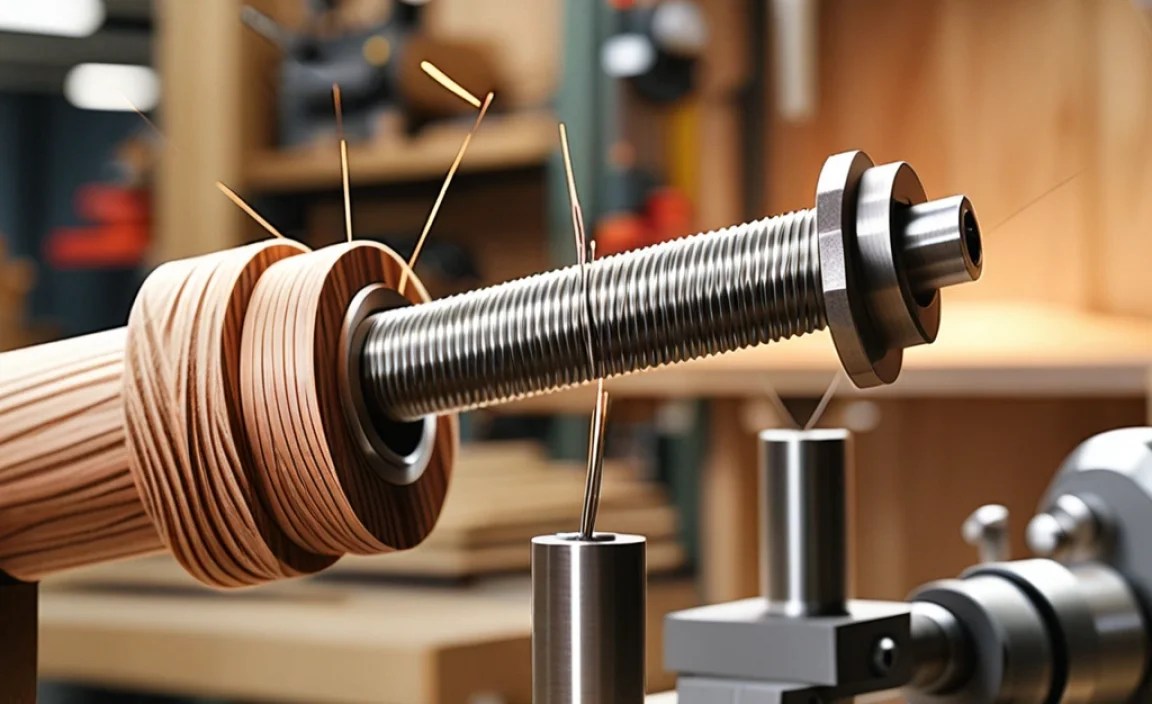
Let’s get this straight from the start: safety on a wood lathe is paramount. The spindle threads are a primary interface for holding your work (or the tool holding your work) in place. Imagine spinning a heavy piece of timber at several hundred or even thousands of revolutions per minute. If the accessory holding that timber, or the method you use to mount an accessory, isn’t perfectly secure due to incompatible threads, the forces involved can be immense. A mismatch can lead to:
- Vibration and Wobble: This stresses the spindle bearings and can lead to inaccurate cuts.
- Loosening During Operation: The accessory could gradually unscrew itself, becoming a projectile.
- Damage to Threads: Forcing an incorrectly sized thread can strip or damage both the spindle and the accessory.
- Catastrophic Failure: In worst-case scenarios, this could result in injury to the operator or damage to the lathe.
Using the correct thread size ensures a tight, secure fit, minimizing these risks and allowing you to focus on the craft of turning wood.
Common Imperial Thread Sizes

For wood lathes, especially those manufactured in North America and popular in the UK, imperial (inch-based) threading is the most common. These threads are specified using a format like “X TPI,” where ‘X’ is the diameter in inches and ‘TPI’ stands for Threads Per Inch. For example, 1″ x 8 TPI means a thread that is 1 inch in diameter and has 8 threads packed into every inch of length.
Here are the most frequently encountered imperial thread sizes you’ll find on wood lathe spindles:
1″ x 8 TPI: The Industry Standard
If you’re buying a new wood lathe from a reputable manufacturer today, there’s an excellent chance its spindle will be threaded 1 inch in diameter with 8 threads per inch. This has become the de facto standard for many modern wood lathes, from smaller hobby machines to larger professional models.
- Diameter: 1 inch
- Threads Per Inch (TPI): 8
- Compatibility: This is the most common size for wood lathe chucks, faceplates, and drive centers. Many manufacturers adopt this standard.
Why is it so common? Standardization is key in tool manufacturing. When a majority of manufacturers agree on a standard, it makes it easier for accessory makers to produce items that fit a wide range of machines. This benefits consumers by offering more choices and often better pricing due to mass production.
3/4″ x 10 TPI: A Smaller, Yet Common Option
While 1″ x 8 TPI dominates, you’ll still find 3/4″ x 10 TPI on many smaller and some older wood lathes. It’s a perfectly capable thread size, just less prevalent in newer, larger models.
- Diameter: 3/4 inch (0.75 inches)
- Threads Per Inch (TPI): 10
- Compatibility: You’ll find this on some benchtop lathes, smaller midi-lathes, and older machines. Many chuck manufacturers do offer adapters or specific models for this thread.
It’s worth noting that 10 TPI means the threads are finer (more of them packed into an inch) than 8 TPI. This can result in a slightly more precise feel and potentially a bit more strength for the given diameter, though the 1″ diameter of the other standard generally offers more overall robustness.
Other Imperial Sizes (Less Common)
While the above two are the most common, especially for chucks, you might encounter other imperial sizes. These are more likely to be found on very old machines, some specialized imports, or on the tailstock spindle (which often has a different thread for the quill). Be aware of these if purchasing used equipment:
- 1″ x 10 TPI: Similar to 1″ x 8 TPI but with finer threads.
- 5/8″ TPI (often a specific pitch, not TPI): Older, often British-made, lathes sometimes used threads specified by diameter and pitch (distance between threads), not TPI. A common one might be M16x2 or similar, which is metric, but some imperial equivalents exist in this style.
- Various other diameters and TPI combinations on very old or custom machines.
Identifying Your Lathe’s Spindle Thread

So, how do you figure out what thread size your lathe has? Don’t guess! Precision is key here. Here are the best methods:
Method 1: Check Your Lathe’s Manual
This is by far the easiest and most reliable method. If you still have the original user manual for your wood lathe, the spindle thread size will almost certainly be listed in the specifications section. Look for terms like “Spindle Thread,” “TPI,” or “Faceplate Thread.”
Method 2: Visual Inspection and Measurement
If you don’t have the manual, you can often figure it out yourself. You’ll need a ruler or calipers and a known thread gauge if you have one.
- Measure the Diameter: Use a ruler or calipers to measure the diameter of the spindle. It’s best to measure the threaded portion. If it looks close to 1 inch or 3/4 inch, that’s your starting point.
- Determine Threads Per Inch (TPI): Place a ruler against the threaded portion of the spindle. Count how many complete threads fit within one inch.
- For example, if you can fit exactly 8 full threads within 1 inch, it’s likely 8 TPI.
- If 10 threads fit within 1 inch, it’s likely 10 TPI.
Tip: If the spindle is shorter than 1 inch, this measurement can be tricky. You can measure over a longer section (e.g., 2 inches) and divide by the number of threads to get the TPI. For instance, if you count 16 threads over 2 inches, that’s 16/2 = 8 TPI.
Method 3: Use a Thread Gauge or Nut/Bolt Combo
If you have a set of thread gauges (often found in tap and die sets or machinists’ toolkits), you can find the one that precisely mates with the spindle threads. Alternatively, you can try fitting common nuts or bolts onto the spindle.
- Start with a 1-inch nut or a 1-inch bolt. Try threading it onto the spindle. If it fits easily and screws on smoothly, it’s very likely 1″ x 8 TPI.
- If the 1-inch nut doesn’t fit, try a 3/4-inch nut or bolt. If that fits smoothly, it’s probably 3/4″ x 10 TPI.
- If neither of those works, you may have one of the less common sizes or a metric thread.
Important Note: When using nuts or bolts, be careful not to force them. If it doesn’t thread on easily, don’t keep turning, as you could damage the threads. You’re looking for a smooth, easy engagement. For this reason, using a gauge or the manual is generally preferred.
Metric Threads: Are They a Thing on Wood Lathes?

While imperial threads are king in the wood lathe world, especially for chucks made for North American and UK markets, you might encounter metric threads on some machines. These are more common on imported machinery, particularly from some European or Asian manufacturers, or on specialized industrial equipment. Metric threads are specified differently, usually as “M” followed by the nominal diameter in millimeters and then the pitch (distance between threads) in millimeters, separated by a cross (e.g., M33 x 3.5). The ‘3.5’ is the pitch, not TPI.
- M33 x 3.5: This is a very common metric threading size found on a lot of European lathes, and increasingly on higher-end machines from various manufacturers. It’s a robust size, roughly equivalent in strength to 1″ x 8 TPI but with a different pitch.
- M18 x 2.5: You might see this on smaller or older machines.
- Other metric sizes are possible depending on the manufacturer and origin of the lathe.
If your lathe has metric threads, you’ll need to ensure any accessories you buy also have the corresponding metric thread. Adapters can sometimes be used, but it’s always best to buy direct-fit accessories if possible.
Common Lathe Accessories and Their Threads
Knowing your spindle thread size is essential for purchasing the right accessories. Here’s a look at some common ones:
Faceplates
Faceplates are flat discs that screw onto the headstock spindle. They are used for mounting larger, irregularly shaped items, or for securely holding work that you might otherwise mount between centers. Many faceplates are sold “spindle-threaded,” meaning they come with a specific thread size already installed. Ensure the one you buy matches your lathe’s spindle.
Typical faceplate threading would match the common spindle sizes: 1″ x 8 TPI or 3/4″ x 10 TPI. You can also find blank faceplates that you can either drill and tap yourself (if you have the tools and skills) or have a machine shop thread for you.
Drive Centers and Spur Drives
These are used to register against the wood itself, often with a point that digs into the material to provide drive from the lathe’s headstock. The threaded portion screws directly onto the spindle. Similar to faceplates, they are usually sold with a specific spindle thread size already integrated.
Scroll Chucks (Keyed Chucks)
These are incredibly versatile tools for woodturning, allowing you to grip workpieces securely from the outside (external jaws) or inside (internal jaws). They are designed to be screwed onto the lathe spindle. Chucks are most commonly sold with a “straight thread” of a specific size, such as 1″ x 8 TPI, 3/4″ x 10 TPI, or M33 x 3.5. You then screw the chuck directly onto your lathe’s spindle.
Purchasing a Chuck: When buying a chuck, double-check the spindle thread specification. If you have an unusual spindle thread, you might need to purchase a chuck with a different thread and then use an adapter. Some chuck manufacturers offer “backplates” or “adapters” that allow their chucks to fit various spindle thread sizes. For example, you might buy a chuck threaded for 1″ x 8 TPI and then purchase a separate adapter that has the correct threading on one side to screw onto your M33 x 3.5 spindle, and the other side to accept the 1″ x 8 TPI chuck body.
Example of Chuck Threading Options:
| Chuck Model Example | Spindle Thread Size | Notes |
|---|---|---|
| Oneway Talon Chuck | 1″ x 8 TPI (Common) | Also available with other thread sizes or adapters. |
| Vicmarc VM120 | M33 x 3.5 (Common) | Often supplied with a removable insert for other thread sizes. |
| Nova G3 Chuck | 1″ x 8 TPI (Common) | Many backplate options available to adapt to different lathes. |
Screw-in Jaws/Threaded Insert Jaws
Some chuck systems allow you to screw separate, specialized jaws directly onto the lathe spindle for specific tasks, like holding a small bowl blank that you’ve already hollowed. These will, of course, need to match your spindle thread size.
Thread Adapters and Reducers
What if your lathe has a less common thread size, or you want to use an accessory that’s threaded for a different size? Adapters are your friend! These are essentially threaded sleeves or bushings that screw into your spindle (or into an accessory) and change the effective thread size.
- Reducer Bushings: These are used to adapt a larger thread to a smaller one. For example, a 1″ x 8 TPI reducer bushing might screw into a faceplate that was originally made for a 1″ x 8 TPI spindle, allowing it to then be screwed onto a 3/4″ x 10 TPI spindle.
- Enlarger Bushings: Less common for wood lathes, but possible. These adapt a smaller thread to a larger one.
- Spindle Adapters: Some chuck manufacturers sell a “backplate” or “insert” that is threaded specifically for your lathe’s spindle (e.g., M33 x 3.5) but provides a standard female thread (e.g., 1″ x 8 TPI) for a chuck designed for that standard.
Always ensure the adapter is securely fastened and that the threads are fully engaged. A poorly fitted adapter can be just as dangerous as a mismatched thread.
When to Use an Adapter vs. Direct Drive
While adapters offer flexibility, there’s a hierarchy of preference:
- Direct Fit: The ideal scenario is when your accessory has threads that precisely match your lathe’s spindle. This offers the most secure and direct connection.
- Threaded Insert/Backplate: Many modern chucks come with or have available inserts. You unscrew the standard thread (e.g., 1″ x 8 TPI) from the chuck body and screw in a specific adapter that matches your lathe’s spindle (e.g., for M33 x 3.5). This is almost as good as a direct fit.
- Adapter Bushings: These are useful but introduce an extra piece. Ensure they are well-made and fit snugly. They are great for using older accessories or when you can’t find a direct-fit option.
Caution: Avoid using adapters that are simply friction-fit or rely on set screws for alignment, especially for high-speed operations. For woodturning, the threads should provide the primary secure connection.
Thread Pitch vs. TPI
We’ve been talking about Threads Per Inch (TPI) for imperial sizes. This is a common way to describe how coarse or fine an imperial thread is. Higher TPI means more threads in an inch, resulting in a finer thread engagement.
For metric threads, the specification is usually Diameter x Pitch (e.g., M33 x 3.5). Here, ‘3.5’ means the distance between the crest of one thread and the crest of the next is 3.5 millimeters. This is a direct measurement of thread spacing, not counting how many fit in a unit length.
It’s important not to confuse TPI with pitch. They are different ways of specifying thread spacing, and an imperial thread will never.
