Wood lathe spindle turning is made simple with these easy techniques to create uniform, balanced, and beautiful pieces for your projects. Master basic cuts, tool control, and finishing for professional results every time.
Turning spindles on a wood lathe can seem daunting at first, but with the right approach, it’s one of the most rewarding skills a woodworker can develop. Many beginners find it frustrating to achieve consistent shapes or smooth finishes, leading to wobbly parts or scraped projects. This guide is here to change that. We’ll break down the process into simple, actionable steps, using proven techniques that ensure success. Get ready to turn those challenging spindle projects into your favorite part of woodworking!
Wood Lathe Spindle Turning: Proven Techniques for Beginners

As Daniel Bates from Lathe Hub, I’ve seen firsthand how many woodworkers feel intimidated by spindle turning. The goal is to create long, relatively thin pieces that are often symmetrical and require a good deal of precision. Getting a clean profile, a smooth finish, and avoiding catches can feel like a secret art. But it’s not! It’s about understanding your tools, your wood, and a few fundamental techniques. This article will walk you through everything you need to know, from selecting your wood to achieving that perfect final polish.
Why Spindle Turning Matters
Spindles are the backbone of many woodworking projects. Think about table legs, bedposts, decorative elements on cabinets, chair spindles, and even baseball bats. The ability to turn them accurately and efficiently is a core skill that elevates your craftsmanship. When a spindle is perfectly round, balanced, and smoothly finished, it instantly makes your entire project look more professional and polished. Conversely, a poorly turned spindle, with flat spots, wobbles, or tear-out, can ruin the appearance and integrity of even the most beautiful piece.
The Essential Toolkit for Spindle Turning
Before we get our hands dirty, let’s make sure you have the right tools. While you can get by with a minimal set, having these items will make your spindle turning experience smoother, safer, and more enjoyable.
Must-Have Wood Lathe Tools:

- Wood Lathe: The centerpiece! For spindle turning, a lathe with a decent swing and headstock/tailstock capacity is ideal, but even smaller benchtop models can handle many spindle projects.
- Chucks/Faceplates: To hold your workpiece securely. A four-jaw chuck is versatile for spindles, but a faceplate can also work.
- Drive Center & Live Center: Essential for supporting the ends of your spindle and allowing it to rotate. A spur drive center bites into the wood, while a live center rotates with the wood.
- Gouge (Spindle Gouge): This is your workhorse for shaping. A 1/2 inch or 3/8 inch spindle gouge is a great starting point for most woods.
- Scraper (Round Nose Scraper): Perfect for smoothing flat or slightly curved surfaces and removing tool marks.
- Parting Tool: For cutting the spindle to length, creating beads, or making narrow grooves. A flat or slightly dished parting tool is useful.
- Safety Gear: Absolutely crucial! This includes a full face shield, hearing protection, and a dust mask.
- Measuring Tools: Calipers (digital or dial) for measuring diameters accurately, and a ruler or tape measure.
- Sandpaper: Various grits (e.g., 80, 120, 180, 220, 320) for sanding the turned piece.
- Finishing Supplies: Your preferred wood finish (e.g., Danish oil, lacquer, wax).
Optional but Highly Recommended Tools:

- Skew Chisel: For shearing cuts that produce very smooth surfaces, especially on end grain and general shaping. Requires more practice to control.
- Beading & Parting Tool: Specialized tools that can make creating decorative beads and precise parting cuts easier.
- Chuck Jaws: Different jaw types for your chuck can expand your workpiece holding capabilities.
Preparing Your Stock for Spindle Turning

The foundation of a good spindle starts with the wood. Here’s how to prepare it correctly.
Choosing the Right Wood
For beginners, it’s best to start with softer, more forgiving woods. These are less likely to cause tear-out and are easier to cut.
- Good Choices: Pine, Poplar, Aspen, Basswood.
- Intermediate Choices: Maple, Cherry, Walnut, Ash. These harder woods will require sharper tools and a bit more finesse.
- Woods to Approach with Caution (for beginners): Oak, exotic hardwoods, and highly figured woods can be challenging due to grain patterns and hardness.
Dimensioning and Balancing Your Blank

- Square the Stock: Start with a square blank. This is crucial for balance. If you’re using dimensional lumber, you might need to rip it to size on a table saw.
- Mark Centerlines: Lightly mark the centerlines on each face of the square blank. This helps you find the center for mounting.
- Cut to Length: Cut your blank slightly longer than the final piece to allow for mounting and trimming.
- Rough Rounding: Some turners prefer to rough-grind the corners off the blank on a grinder or with a bandsaw. This reduces vibration and the risk of a dangerous catch when you first start turning. Even a coarse rasp can do this.
Mounting Your Spindle Blank
Securely mounting your workpiece is paramount for safety and successful turning.
Using a Drive Center and Live Center (Between Centers)

This is the most common method for spindle turning.
- Install the Drive Center: Screw or tap the drive center into the headstock spindle.
- Mount the Blank: Align the centerlines on your blank with the drive center. You can tap the drive center into the wood with a hammer, ensuring it bites firmly.
- Install the Live Center: Place your tailstock on the lathe bed. Insert the live center into the tailstock quill.
- Advance the Tailstock: Extend the tailstock quill until the live center just touches the far end of your wood blank.
- Lock and Advance: Lock the tailstock in position. Advance the tailstock quill using the handwheel to apply firm but not excessive pressure. You want the wood to be snug but not so tight that it binds the tailstock.
- Check for Wobble: Briefly turn the lathe on at a very slow speed (e.g., 300-500 RPM) and check for significant wobble. If there’s excessive wobble, stop the lathe, re-center your blank, adjust tailstock pressure, and try again.
Using a Chuck

If your spindle is meant to be mounted in a chuck, follow these steps:
- Install the Chuck: Mount your chosen chuck onto the lathe spindle.
- Prepare the Blank: You’ll likely need to turn one end of your blank flat and mark the center for chucking. For longer spindles, you might still use a live center in the tailstock for support.
- Chuck the Blank: Insert the prepared end of the blank into the appropriate jaws of your chuck. Tighten securely.
- Support with Live Center (if applicable): If turning a long spindle, bring a live center from the tailstock to support the free end.
Fundamental Cutting Techniques for Spindle Turning

With your blank mounted and safety gear on, it’s time to shape your wood. Always start at a slower speed and gradually increase as the piece becomes rounder and balanced. A good rule of thumb is to start below 1000 RPM and go up to 2000 RPM or more for higher grit sanding, depending on the wood and lathe size. Consult your lathe’s manual for recommended speeds.
Roughing the Blank Round
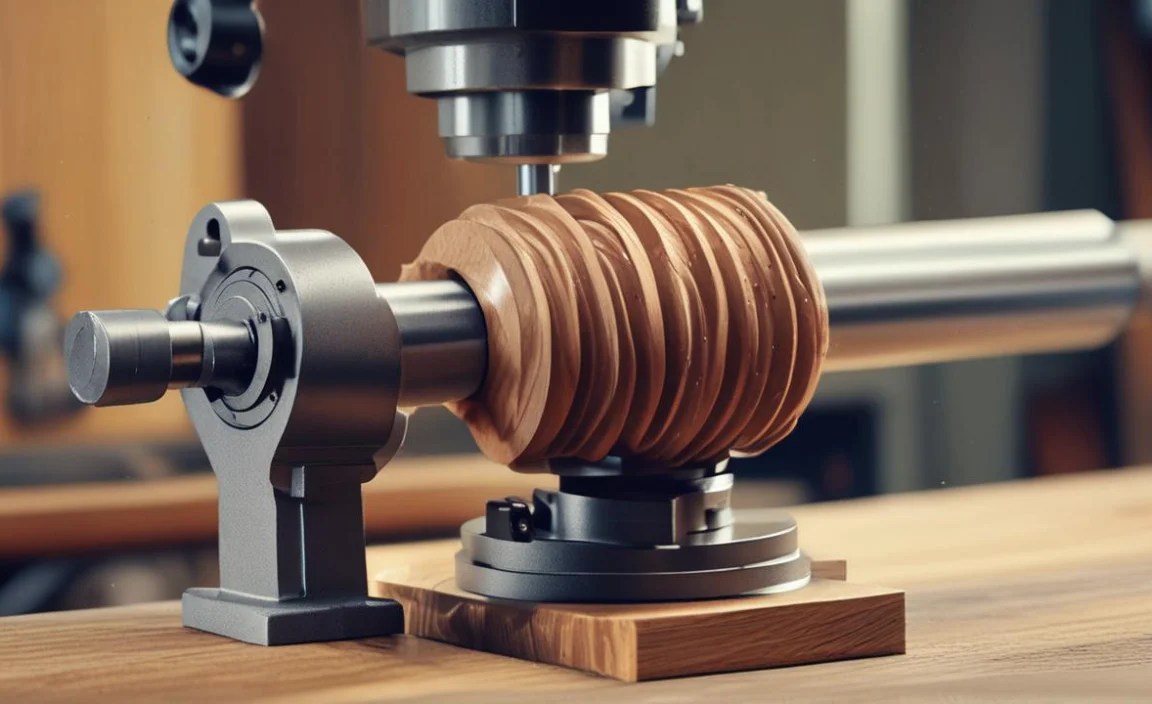
Your first task is to remove the corners and get the blank as perfectly round as possible.
- Tool Selection: Use a spindle gouge.
- Gouge Angle: Hold the gouge with the flute (the hollow part) facing slightly upward, at about a 45-degree angle to the wood surface.
- Cut Direction: Start at the headstock end and move towards the tailstock, or vice-versa consistently. Most turners start at the headstock and move away.
- Cutting Action: Make light, scraping-like cuts. Don’t try to hog off large amounts of wood at once. The goal is to shave off the corners smoothly.
- Bevel Contact: Ensure the bevel of the gouge is rubbing against the wood. This tells you you’re at the correct cutting angle.
- Controlled Pass: Make a slow, steady pass across the entire length of the blank. You’ll see shavings transform from triangular chips to more uniform curls as it rounds up.
- Repeat: Make subsequent passes, slightly overlapping the previous cut, until the entire blank is a consistent cylinder. Stop frequently to check for roundness.
Making a Basic Cut (Shearing Cut with Gouge)

Once your blank is round, you’ll start shaping your spindle. A common technique is the shearing cut with a spindle gouge.
- Tool Positioning: Hold the spindle gouge with the flute angled significantly towards the direction of your cut, often almost perpendicular to the wood surface, with the bevel rubbing.
- Starting Point: Position the gouge where you want to start your cut, at the desired diameter.
- Cutting Motion: Gently push the gouge into the wood, letting the bevel rub. Move the tool slowly along the length of the spindle. The cut should peel off fine shavings.
- Depth of Cut: Take light cuts. Resist the temptation to cut too deeply, especially with harder woods or at faster speeds, as this can lead to catches.
- Consistency: Aim for a smooth, continuous motion to achieve a clean cut.
Creating Beads and Coves (Using a Gouge and Parting Tool)

Decorative elements like beads and coves add significant visual interest.
Creating Beads:
- Mark the Bead Location: Use a pencil or calipers to mark the width of the bead.
- Cut Dividers: Use a parting tool to cut two shallow grooves to define the width of the bead. Sand the bottom of these grooves to create a small radius.
- Shape with Gouge: Position your spindle gouge so the flute is almost perpendicular to the wood, or even slightly angled away, to create a scraping cut. Gradually bring the cutting edge into the wood between the dividing grooves, working from the sides towards the center. Take very light cuts and let the bevel ride on the wood. The goal is to round the surface between the grooves.
Creating Coves:
- Mark the Cove Location: Mark where the cove will be.
- Use the Gouge: Hold the spindle gouge with the flute angled towards the wood, at a tangent to the desired curve.
- Cutting Motion: Slowly allow the gouge to sink into the wood, pivoting it slightly to deepen the curve. The bevel should rub against the wood. Take light, controlled passes.
- Depth Control: The depth is controlled by how much you sink the gouge and its angle. Aim for a clean, smooth arc.
Using a Scraper for Smoothing

Scrapers are excellent for finishing surfaces after using gouges and for removing tool marks.
- Tool: A round-nose scraper is ideal for spindle turning.
- Positioning: Hold the scraper with the flat part angled slightly downwards, so the edge is just kissing the wood. The bevel should not be rubbing.
- Cutting Action: Push the scraper slowly along the wood surface. It acts like a very sharp knife, “scraping” off a thin layer of wood.
- Burnishing (Optional): You can “burnish” the edge of the scraper by rubbing a hardened steel rod (a burnisher) along the cutting edge. This creates a tiny wire edge that scrapes more aggressively, producing a very smooth finish. Be cautious, as a burnished scraper can be prone to catching.
- Direction: Scrapers can usually be used in either direction, but often work best when moving away from the headstock.
Advanced Spindle Turning Techniques

Once you’re comfortable with the basics, you can explore more advanced methods for efficiency and enhanced finishes.
The Power of the Skew Chisel

The skew chisel, when mastered, can produce incredibly smooth surfaces with a single pass.
- Shearing Cuts: The primary use for spindle turning is making shearing cuts. Position the skew with its angle cutting across the wood, not straight on. The bevel should rub against the wood.
- Taming the Catch: The biggest challenge with a skew is preventing catches, which happen when the cutting edge digs in and tears the wood. This is often due to incorrect angle, too much pressure, or a dull edge. Practice slow, controlled movements and always ensure the bevel is rubbing.
- End Grain Finishes: Skew chisels are excellent for smoothing end grain, which is often tricky.
Tapering and Contouring

Creating tapers (gradual changes in diameter) and complex contours is fundamental to classic spindle design.
- Marking: Use calipers or a ruler to mark your desired diameters at the start and end of any taper or where major contour changes occur.
- Gradual Removal: Use your gouge or skew in a series of light, controlled passes. Gradually reduce the diameter of the wood, checking with calipers frequently.
- Forming Curves: For convex curves (bulges), use a sweeping cut with your gouge, pivoting it as you move along the spindle. For concave curves (like coves), use the gouge with the flute angled more directly into the wood, or employ the scraping technique.
Achieving a Glass-Smooth Finish: Sanding and Beyond

The finish you achieve on a spindle greatly impacts its look and feel.
- Tool Marks Removal: Before sanding, ensure all major tool marks are removed with scrapers or very light scraping cuts with your gouge/skew.
- Start Sanding: Begin with a coarser grit (e.g., 80 or 120) to remove any remaining irregularities. Ensure the lathe is stopped when changing sandpaper grits to avoid catching.
- Progress Through Grits: Gradually move up through finer grits (180, 220, 320, and even 400). Sand each grit thoroughly before moving to the next.
- Sand with the Lathe Running Slow: It’s generally best to sand at relatively low speeds (around 1000-1500 RPM for coarser grits, up to 2500+ for finer grits – always check user manuals).
- Sandpaper Technique: Wrap sandpaper around a cork block or a piece of hard rubber to apply even pressure. Move the sandpaper back and forth along the length of the spindle, not just in one spot.
- “Raising the Grain” (Optional): After sanding with 180 or 220 grit, you can lightly dampen the wood with water. Let it dry completely. This will raise the grain, making any stray fibers stand up. Then, sand again with your finest grit. This step is particularly useful for open-grained woods and dramatically improves the final finish.
- Between Sanding and Finishing: Wipe down the spindle with a tack cloth or a slightly damp cloth to remove all dust immediately before applying finish.
Safety First: Essential Precautions for Spindle Turning

Safety cannot be overemphasized when operating a wood lathe. Spindles, being long and thin, can be prone to vibration and catching, making safety practices even more critical.
Key Safety Practices:

- Wear Your Face Shield: Debris can fly off at high speed. A full face shield is non-negotiable.
- Eye Protection: Wear safety glasses under your face shield for an extra layer of protection.
- Hearing Protection: Lathes can be noisy. Wear earplugs or earmuffs.
- Dust Mask/Respirator: Wood dust is a health hazard. Always use appropriate respiratory protection.
- Appropriate Clothing: Avoid loose clothing, jewelry, or anything that can get caught in the spinning lathe. Tie back long hair.
- Tool Rest Positioning: Ensure tool rests are positioned very close to the workpiece (about 1/8 inch clearance) to prevent the tool from getting caught beneath it.
- Secure Workpiece: Always double-check that your workpiece is securely mounted and that the tailstock is properly advanced and locked.
- Start Slow: Begin turning at the slowest spindle speed, especially when roughing out. Gradually increase speed as the wood becomes round and balanced.
- Sharp Tools: Dull tools are more dangerous than sharp ones as they require more force and are prone to catching. Sharpen your tools regularly.
- Know Your Lathe: Read and understand your lathe’s manual, including its recommended speed ranges for different operations and wood types.
- Clear Workspace: Keep your work area clean and free of clutter.
