A wood lathe spindle sander attachment makes smoothing and shaping spindles a breeze, drastically reducing hand-sanding time and improving the finish on your turned projects. This guide helps you choose the right one for your needs, ensuring a perfect fit and optimal performance for your woodworking tasks.
Welcome to Lathe Hub! Ever spent what felt like hours meticulously sanding a spindle, only to feel like you could have done better? You’re not alone. Getting that perfectly smooth, uniform finish on turned pieces, especially spindles, can be a real challenge. Many woodworkers find themselves wrestling with sandpaper and awkward angles, wishing for a more efficient way. That’s where a wood lathe spindle sander attachment comes in. It’s a game-changer for achieving professional-looking results with less effort. In this guide, we’ll walk through everything you need to know to pick the perfect spindle sander attachment for your lathe, so you can spend less time sanding and more time creating. Let’s get started and transform your finishing process!
What is a Wood Lathe Spindle Sander Attachment?

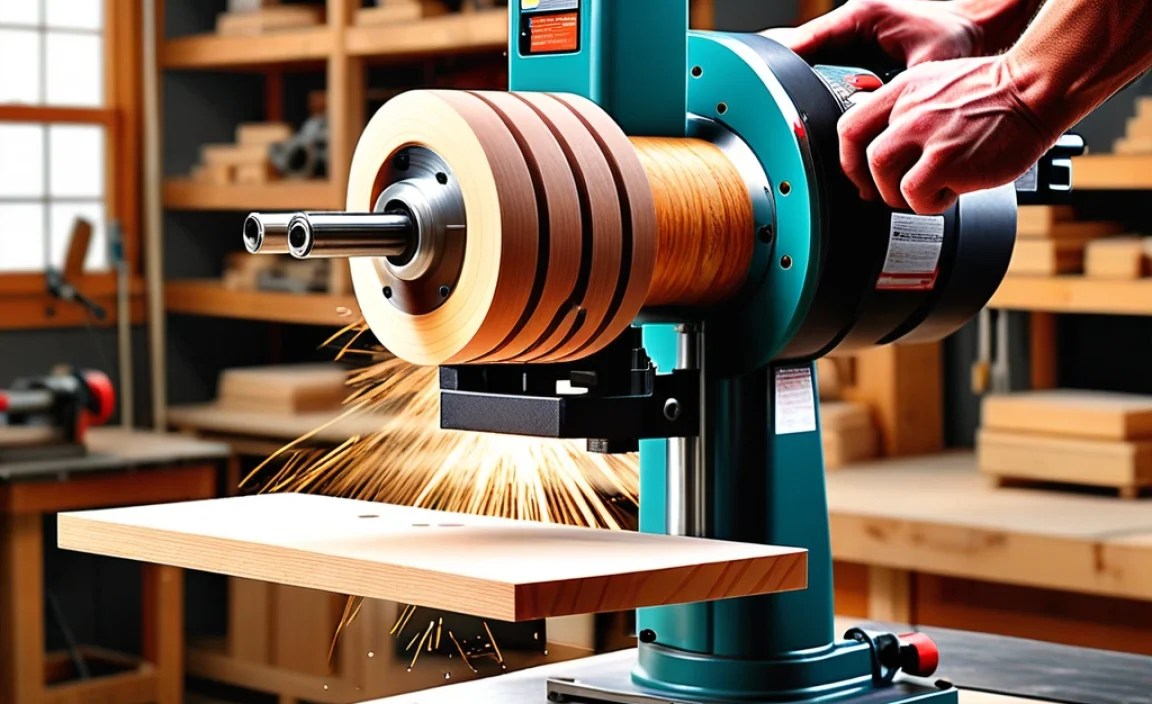
A wood lathe spindle sander attachment is a specialized tool designed to connect to your wood lathe, converting it into an efficient sanding machine for spindles, table legs, balusters, and other cylindrical or tapered turnings. Essentially, it uses a rotating drum around which sandpaper is wrapped to provide a consistent sanding surface that conforms to your workpiece. Instead of moving sandpaper around a stationary or slowly rotating piece, the workpiece (your spindle) remains stationary or moves slightly while the powered sanding drum does the heavy lifting. This allows for very even smoothing and shaping, significantly cutting down on the time and effort required compared to traditional hand-sanding methods.
Think of it as a stationary belt sander or drum sander, but specifically designed to work in conjunction with your lathe. This makes it an invaluable tool for anyone who frequently turns spindles, furniture components, or any other turned items where a smooth finish is crucial. It’s about bringing precision and efficiency to a task that can often be tedious.
Why You Need a Spindle Sander Attachment

If you’ve ever felt the frustration of uneven sanding, trying to reach tight corners, or simply dedicating too much time to finishing, a spindle sander attachment is your answer. Here’s why it’s a standout addition to your workshop:
- Efficiency: The most significant benefit is the time saved. A spindle sander attachment drastically reduces the hours spent on manual sanding. It allows you to achieve a smoother finish in a fraction of the time.
- Consistent Finish: Achieving a uniform grit progression and even pressure by hand can be difficult. The attachment’s powered drum provides consistent contact, leading to a much smoother and more predictable finish across the entire piece.
- Ergonomics and Comfort: Hand-sanding for extended periods can be hard on your hands, wrists, and back. Using a spindle sander attachment makes the process much more comfortable and less physically demanding.
- Versatility: While primarily for spindles, many attachments can also handle other turned items like bowls (the inside or rim), small bowls, or even items with intricate shapes.
- Improved Results: The consistent sanding action leads to higher quality results. You can achieve a finer grit finish more easily, preparing your work perfectly for paint, stain, or clear coats.
- Reduced Dust: While no sanding process is dust-free, a well-equipped setup with a dust collection port can help manage the airborne dust more effectively than manual sanding.
For woodworkers who value their time, the quality of their finished products, and their own physical comfort, a spindle sander attachment isn’t just a tool—it’s an upgrade to your entire woodworking process. It streamlines the finishing stage, allowing you to move on to the next project or enjoy your completed work sooner.
Types of Spindle Sander Attachments

Spindle sander attachments come in a few variations, each with its own advantages. Understanding these differences will help you pinpoint the best fit for your lathe and workflow.
1. Drum Sanders with Lathe Adapters
These are often standalone drum sanders designed for benchtop use, but they come with adaptors or can be positioned to work with your lathe’s tools. They typically feature a cylindrical drum that rotates, and you feed your workpiece against it. Some models are designed to mount directly to your lathe’s tool rest post, essentially becoming part of the lathe setup. The drum size and speed are key factors here.
Pros:
- Can offer larger drum diameters for faster material removal.
- Often have dust collection ports built-in.
- Can sometimes be used independently as a small benchtop sander.
Cons:
- Can be bulkier and take up more space.
- May require more setup or adjustment to align with the lathe.
- Can be more expensive than simpler spindle attachments.
2. Integrated Spindle Sander Kits
These are designed specifically to integrate with a particular brand or model of wood lathe. They often connect via the tool post or a dedicated mounting point on the lathe bed. The sanding drum rotates via the lathe’s motor or a separate motor, and the woodworking piece is mounted on the lathe’s headstock and tailstock. Think of these as an extension of the lathe itself.
Pros:
- Designed for a perfect fit and easy integration.
- Often have a streamlined design that doesn’t interfere with lathe operation.
- Can offer precise alignment and stable operation.
Cons:
- May be brand-specific, limiting compatibility.
- Can be less versatile if you switch lathe brands.
- Might have fewer features than some standalone drum sanders.
3. Oscillating Spindle Sanders
These are more advanced and typically larger, standalone machines. While not always a direct “attachment” in the sense of mounting onto your lathe, they are a common and highly effective solution for spindle sanding. They combine rotation with an up-and-down oscillating motion of the sanding sleeve. This oscillation helps to prevent flat spots from forming on the workpiece and can lead to an even smoother finish more quickly.
Pros:
- Excellent for achieving very smooth finishes quickly.
- Oscillation significantly reduces the risk of over-sanding or creating imperfections.
- Can handle a wide range of spindle sizes and shapes.
Cons:
- Larger footprint and higher cost.
- Not a direct lathe attachment, requiring separate floor space.
- Oscillation might be overkill for very simple, small spindles.
Key Features to Consider When Buying
When you’re ready to invest in a spindle sander attachment, several features will make a big difference in its usability, effectiveness, and longevity. Don’t just grab the first one you see; consider these points carefully:
1. Spindle/Drum Diameter and Size
The diameter of the sanding drum is crucial. Larger drums generally remove material faster and can handle larger workpieces more efficiently. Common sizes range from 1 inch to 4 inches in diameter. Consider the typical size of the spindles or turned items you create. If you mostly work on smaller craft projects, a smaller drum might suffice. For larger furniture components, a larger drum is beneficial.
2. Spindle/Drum Length
The sander will usually come with one or more sanding sleeves, each with a specific length. A longer sleeve provides more sanding surface area, allowing you to sand larger sections of your workpiece at once. This can speed up the process for long spindles or table legs.
3. Spindle Speed (RPM)
The speed at which the sanding drum rotates is important for effective sanding. Higher RPMs generally mean faster material removal. However, too high a speed can lead to excessive heat buildup, potentially scorching your wood, and can make the sander harder to control. Look for a sander that offers variable speed control if possible, allowing you to adjust the speed based on the wood type, grit of the sandpaper, and the amount of material you need to remove.
4. Table or Support Surface
The attachment needs a stable platform to rest your workpiece on while sanding. Some attachments have integrated support tables, while others rely on your lathe’s tool rest. A well-designed table will be flat, sturdy, and allow for easy adjustment to accommodate different workpiece diameters. For attachments that mount to the tool rest, ensure it’s robust enough to support the forces involved.
5. Dust Collection Capability
Sanding creates a lot of fine dust, which is bad for your health and your workshop environment. Look for an attachment that has a dust collection port compatible with your shop’s dust collection system. This can significantly reduce airborne dust, making your workspace cleaner and safer. A port size of 1.5 inches or 2 inches is common.
6. Material Compatibility
While this guide focuses on wood lathes, it’s worth noting that some spindle sanders are more suited for certain types of wood or applications. For example, very soft woods might require lower speeds to avoid burning, while hardwoods might benefit from higher speeds but finer grit sandpaper. Ensure the attachment you choose can handle the range of materials you typically work with.
7. Durability and Construction
Look for attachments made from sturdy materials like cast iron or heavy-duty steel. Ball bearings should be sealed and smooth-running. Read reviews to gauge the overall build quality and how well it holds up to regular use. A well-built attachment will be a long-term investment.
8. Ease of Use and Setup
How easy is it to attach to your lathe? How quickly can you change sandpaper sleeves? Can you adjust it easily for different spindle sizes? A user-friendly design will save you time and frustration in the long run. Quick-release mechanisms for sleeves and simple adjustments are highly desirable.
9. Price and Brand Reputation
Spindle sander attachments can range from under $100 to several hundred dollars. Set a budget based on your needs and research reputable brands known for quality woodworking tools. Reading reviews from other users is a great way to sort through options and find good value.
How to Choose the Right Spindle Sander Attachment for Your Lathe

Selecting the perfect spindle sander attachment depends on your specific lathe, your woodworking projects, and your budget. Here’s a step-by-step approach to help you make the best choice:
Step 1: Assess Your Lathe
First, understand your lathe’s capabilities and mounting options. What is the distance from your tool rest post to the headstock or tailstock? Does your lathe have any specific mounting points or accessories it’s designed for? Some attachments are universal, while others are designed for specific lathe brands or models (e.g., Delta, Grizzly, Jet, Powermatic). Knowing your lathe’s specifications is crucial for compatibility.
Step 2: Identify Your Primary Use Cases
What will you be sanding most often?
Small, intricate spindles for craft projects? A smaller diameter drum (1-2 inches) with a shorter length might be sufficient and more maneuverable.
Larger furniture legs, balusters, or table posts? You’ll likely benefit from a larger drum diameter (3-4 inches) and a longer sanding sleeve for quicker material removal and wider coverage.
A mix of both? Look for attachments that come with multiple drum sizes or offer good versatility.
Do you need to sand internal curves of bowls? Some attachments can be adapted for this, but dedicated bowl sanders or other accessories might be better suited.
Step 3: Consider the Sanding Sleeves
Sleeves are the consumable part of your spindle sander. Check the availability and cost of replacement sleeves for the attachment you’re considering. Most attachments come with a set of common grits (e.g., 80, 120, 220), but you’ll need to replenish them. Interchangeable sleeves are a must.
Step 4: Evaluate Dust Collection
If you have a dust collection system in your shop, prioritize attachments with compatible dust ports. A clean workspace is essential for safety and finish quality. If you don’t have dust collection, consider the amount of dust the attachment might generate and how you’ll manage it.
Step 5: Determine Your Budget
Prices vary significantly.
Entry-level: Basic drum sanders with lathe adapters might be found for $50-$150.
Mid-range: More robust, integrated kits with better features can cost $200-$400.
High-end/Oscillating: Professional-grade oscillating spindle sanders can be $500 and upwards.
Determine how much you’re willing to invest and how often you’ll use the tool to justify the cost.
Step 6: Read Reviews and Seek Recommendations
Once you’ve narrowed down your options, spend time reading online reviews from fellow woodworkers. Look for comments on durability, ease of use, effectiveness, and any common issues. If possible, ask other woodworkers in your local community or online forums for their recommendations. A tool that works well for someone with similar projects and lathe setup to yours is likely a good choice.
Step 7: Check for Attachments and Accessories
Some attachments offer optional accessories, like different-sized drums, specialized guides, or extended supports. These can add to the versatility and functionality of the core attachment, so consider if any of these are of interest to you.
Buying Guide Table: Spindle Sander Attachment Features
To help you compare, here’s a table summarizing key features and what to look for:
| Feature | What to Look For | Why It Matters |
|---|---|---|
| Drum Diameter | 1-4 inches (depending on typical project size) | Larger diameters sand faster and handle bigger pieces. |
| Drum Length | Sufficient for your longest spindles/components | Longer length means more sanding surface area at once. |
| Spindle Speed | Variable speed is ideal; 2000-4000 RPM is common. | Adjustable speed prevents scorching and allows for different grits/woods. |
| Mounting System | Secure and compatible with your lathe (tool rest, stand-alone). | Ensures stability and safety during operation. |
| Dust Collection | Integrated port (1.5″ or 2″ is common) | Crucial for health, cleanliness, and a better finish. |
| Build Quality | Sturdy metal construction (cast iron, steel), smooth bearings. | Durability, longevity, and vibration-free operation. |
| Sanding Sleeve Variety | Easy to change, wide availability of grits and sizes. | Consumables are necessary; ensure they’re accessible and affordable. |
| Table/Support | Stable, flat, and adjustable for different diameters. | Provides a reliable surface for workpiece support during sanding. |
Installation and Setup: Getting Started
Once you have your spindle sander attachment, getting it ready for use is usually straightforward. The specific steps will vary depending on the model, but here’s a general guide:
1. Read the Manual
This is the most crucial step. Every attachment is different, and the manufacturer’s instructions are your best guide for safe and correct setup. Pay close attention to any warnings or specific instructions.
2. Mount the Attachment to Your Lathe
Tool Rest Mounted: This type often slides into your lathe’s tool rest holder. Ensure it’s seated firmly and clamped securely. Make sure the height is adjustable to match your workpiece.
* Dedicated Mount: Some are designed to bolt onto a specific point on your lathe bed or tool post. Follow the provided hardware and instructions diligently.
3. Install the Sanding Sleeve
Most sander drums have a rubber or expandable surface. You simply slide a folded sandpaper sleeve over the drum. Some designs require you to inflate a rubber drum slightly to grip the paper, while others have screws or clips to hold the sleeve in place. Ensure the sleeve is snug to prevent slipping or tearing.
4. Align with Your Lathe
The sanding drum should be aligned so that it’s parallel to your lathe’s bed and the sanding surface is at a comfortable height for your workpiece. If the attachment has an adjustable table, set it to support the workpiece at the desired angle.
5. Connect Dust Collection (If Applicable)
Attach your dust hose to the dust port on the sander attachment. Ensure a good seal for maximum dust capture.
6. Perform a Test Run
Before you bring your workpiece to the sander, turn on the sander (and your lathe if it’s powered by the lathe) and let it run for a minute to check for vibrations or unusual noises. Ensure everything is stable and secure.
How to Use Your Spindle Sander Attachment Safely and Effectively
Using a spindle sander attachment is much simpler than hand-sanding, but safety and technique are still paramount.
