Wood lathe faceplate installation is straightforward when you follow these essential steps, ensuring a secure and reliable connection for your turning projects. This guide will walk you through the process, from selecting the right faceplate to properly mounting it for safe operation.
Hey there, fellow makers! Daniel Bates here from Lathe Hub. Ever found yourself admiring a beautifully turned bowl or spindle and wondering how it’s all held securely to the lathe? A key player in that stability is the faceplate. Sometimes, getting it installed correctly can feel a bit fiddly, especially when you’re just starting out. You might worry about alignment, thread damage, or whether it’s truly secure. But don’t sweat it! This guide is designed to make wood lathe faceplate installation as easy as pie. We’ll break it down step-by-step, so you can get back to creating amazing woodturnings with confidence.
What is a Wood Lathe Faceplate and Why Use One?

A wood lathe faceplate is a metal disc with a threaded hole that screws onto the lathe’s spindle. It provides a robust and flat surface to attach larger or irregularly shaped workpieces that can’t be easily held by a chuck or between centers. Think of it as a sturdy mounting plate for your wood. When you need to turn something substantial, like a large bowl blank, a platter, or even something a bit off-balance, the faceplate offers the most secure and stable way to hold it.
The primary reason for using a faceplate is the sheer holding power and versatility it offers. Unlike a chuck, which grips the workpiece directly, a faceplate allows you to attach your wood blank using screws or glue. This is invaluable for projects where the shape of the wood itself dictates the turning process, or when the blank is too large or awkward for other methods. It’s a fundamental accessory for any serious woodturner looking to tackle bigger or more challenging projects.
Types of Wood Lathe Faceplates

Faceplates generally come in a few common types, primarily differing in their mounting thread size and overall construction. Understanding these can help you choose the right one for your lathe and your projects. The most critical factor is matching the thread size to your lathe’s spindle – trying to force the wrong one can damage both.
- Threaded Faceplates: These are the most common. They have a threaded bore that screws directly onto the male thread of your lathe’s spindle. The size of the thread (e.g., 1″ x 8 TPI, 3/4″ x 10 TPI) is crucial. Always verify your lathe’s spindle thread specification before purchasing.
- Universal Faceplates: Some faceplates are designed with unthreaded or oversized bores, intended to be drilled and tapped by the user to match a specific application. These are less common for general-purpose use and are often found in specialized setups.
- Bolt-On Faceplates (Less Common for Standard Lathes): While less typical for typical wood lathes, some industrial or specialized machines might use faceplates that bolt onto a flange rather than screw onto a spindle thread. For most home and hobbyist wood lathes, you’ll be dealing with threaded faceplates.
Beyond the threading, you’ll also see variations in the thickness and diameter of the faceplate, and the number and size of mounting holes for attaching your wood. Thicker, larger faceplates are generally more robust and suitable for heavier workpieces.
Choosing the Right Faceplate for Your Lathe

Selecting the correct faceplate is the first and most crucial step. A mismatch here can lead to frustration, damage, or even unsafe operation. The single most important specification is the spindle thread size of your wood lathe.
How to Find Your Lathe’s Spindle Thread Size:
- Check Your Manual: The safest and easiest way is to consult your lathe’s owner’s manual. It will clearly state the spindle thread size (e.g., “1 x 8 TPI” or “M33 x 3.5”).
- Measure the Spindle End: If you don’t have the manual, you can try to measure the spindle end. You’ll need to determine both the major diameter of the thread and the number of threads per inch (TPI) or the thread pitch (distance between threads for metric). You can use a thread gauge or a ruler to estimate TPI, but it’s less precise than checking the manual.
- Look for Markings: Sometimes, the thread size is stamped directly onto the spindle end or the existing faceplate/chuck adapter.
| Lathe Type/Brand | Common Spindle Thread Size |
|---|---|
| Delta/Rockwell | 1″ x 8 TPI |
| Powermatic | 1″ x 8 TPI, 3/4″ x 16 TPI |
| Jet | 1″ x 8 TPI, M33 x 3.5 |
| Grizzly | 1″ x 8 TPI, 3/4″ x 10 TPI, M33 x 3.5 |
| Sieg/Clarke | M33 x 3.5 |
Note: This table provides common examples. Always verify your specific lathe model’s specifications.
Once you have the thread size, choose a faceplate from a reputable manufacturer that matches. Consider the diameter and thickness – a larger diameter faceplate offers more surface area for attaching larger blanks, while a thicker plate is more robust. For beginners, a standard 3″ or 4″ diameter faceplate with a good number of mounting holes is usually a great starting point.
Essential Tools and Materials
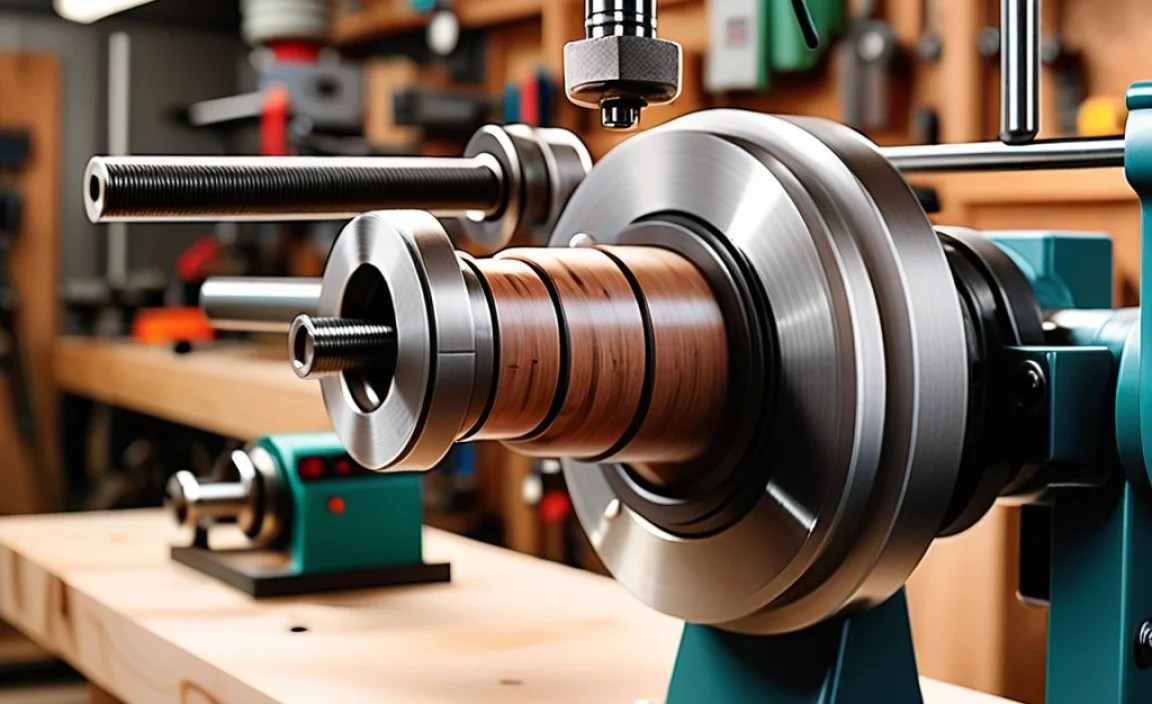
Before you begin the installation, gather everything you’ll need. Having all your tools and materials ready will make the process smoother and safer.
- Correctly Sized Faceplate: As discussed, ensure it matches your lathe’s spindle thread.
- Wood Lathe: Make sure it’s powered off and unplugged.
- Adjustable Wrench or Spanner: To tighten the faceplate onto the spindle. Check if your lathe requires a specific spanner wrench that came with the machine.
- Safety Glasses: Always wear them when working with machinery.
- Shop Rags: For cleaning threads and surfaces.
- Thread Lubricant (Optional but Recommended): A small amount of brass-safe lubricant or anti-seize compound can help prevent threads from galling and make future removal easier. Avoid petroleum-based lubricants that can degrade rubber components if present elsewhere on the lathe.
- Piece of Wood (for testing): A small, scrap piece of wood to practice attaching and turning.
- Appropriate Screws: If you plan to attach wood directly to the faceplate with screws, have a selection of wood screws with appropriate lengths and diameters. Ensure they are sharp and suitable for your wood type.
- Drill Bits and Drill (if pre-drilling your workpiece): For creating pilot holes for screws.
Step-by-Step: Installing Your Wood Lathe Faceplate
Safety is paramount. Always ensure your lathe is unplugged and the headstock is stationary before starting this process.
Step 1: Prepare the Lathe Spindle
Locate the end of your lathe’s spindle. It’s the part that protrudes from the headstock. If you have a tailstock, you might want to extend it slightly to assist in stabilizing the headstock during tightening, but ensure it’s locked firmly in place and not interfering with your working space.
Use a clean shop rag to wipe down the spindle threads. Remove any dust, old lubricant, or debris. Clean threads ensure a good, secure fit and prevent potential damage. If there’s any rust or stubborn residue, you might need a brass brush, but be gentle to avoid damaging the threads themselves.
Step 2: Apply Lubricant (Optional but Recommended)
For a smoother installation and easier removal later, consider applying a small amount of lubricant. Use a brass-safe lubricant or a dab of anti-seize compound. Apply it sparingly to the spindle threads. This helps prevent the threads from binding or galling, especially on cast iron or steel spindles. Wipe away any excess – you only need a thin film.
Step 3: Align the Faceplate
Take your wood lathe faceplate. On the back side of the faceplate, you’ll see the threaded hole. Carefully bring the faceplate towards the spindle. Align the threads of the faceplate with the threads on the spindle. It’s often helpful to start by hand.
Gently try to turn the faceplate counter-clockwise. This is the standard direction for tightening on most lathes. If it doesn’t immediately thread on smoothly, don’t force it. Spin it backward a bit, re-align, and try again. Forcing it can cross-thread, which will damage both sets of threads. You should feel the threads engage and start to turn the faceplate onto the spindle.
Step 4: Thread the Faceplate On by Hand
Once you feel the threads engage correctly, continue to screw the faceplate onto the spindle by hand as far as it will go. This ensures the threads are properly seated and eliminates any possibility of cross-threading. You’ll feel it become snug against the face of the headstock or any spindle shoulder.
Step 5: Tighten the Faceplate
Now, use your adjustable wrench or the specific spanner wrench for your lathe. Place it on the faceplate’s drive flats or appropriate wrenching surface. Apply firm, steady pressure to tighten the faceplate securely onto the spindle. You want it good and snug, but avoid over-tightening to the point where you risk damaging the spindle threads or the faceplate itself. A very slight snug is usually sufficient, as the turning forces will help seat it further. If your lathe has a spindle lock, engage it now for an extra secure tightening. Check your lathe’s manual for specific tightening recommendations.
Step 6: Check for Runout
With the faceplate installed and snug, it’s a good idea to check for runout. While a perfectly true faceplate is ideal, a tiny amount of runout is often acceptable, especially for larger workpieces where imperfections might be less noticeable. You can use a dial indicator mounted to the tool rest to measure the runout on the face of the faceplate. Alternatively, you can place a pencil tip against the faceplate as you slowly rotate the headstock by hand. If the pencil mark is consistent, you have minimal runout. If it significantly varies, it might indicate an issue with the faceplate or the spindle threads.
Step 7: Prepare Your Wood Blank
Before you attach your wood blank to the faceplate, prepare it. For large blanks, it’s often best to first find the approximate center and drill a pilot hole that’s slightly smaller than the diameter of the screws you intend to use. This prevents the wood from splitting when you drive the screws in, especially if you’re using hardwood.
You can also use a compass to draw a circle on your blank that marks the boundary of your faceplate’s mounting screw holes. This helps you visualize where to drill and how far out your screws will go. For really large or irregularly shaped blanks, you might decide to secure the wood using lag bolts, or even glue and screw it onto a piece of plywood backed by the faceplate (a Faceplate Ring).
Step 8: Attaching Wood to the Faceplate
There are several common methods for attaching your wood blank to the faceplate:
- Screws: This is the most common method. Place your prepared wood blank against the faceplate, aligning its center as best as possible with the spindle’s center. Drive wood screws through the mounting holes of the faceplate and into your wood blank. Use screws that are long enough to get a good grip in the wood but not so long that they poke through the other side, unless that’s intentional. Ensure the screws are evenly spaced and equally tightened.
- Double-Sided Tape and Screws: For a strong initial bond and to help seal against dust, some turners use heavy-duty double-sided tape in conjunction with screws. Apply the tape to the wood blank or the faceplate, press the pieces together, then drive screws through the holes.
- Glue and Screws: A strong wood glue applied between the faceplate and the blank, followed by screws, provides a very robust bond.
- Faceplate Ring: For very large or difficult-to-mount pieces, you can buy or make a “faceplate ring.” This is a larger diameter, thinner faceplate with many more screw holes. You attach this ring to your workpiece first, and then attach the actual faceplate to the ring. This distributes the holding forces over a much larger area.
When screwing into the wood, work progressively. Don’t fully tighten one screw immediately. Partially tighten screws on opposite sides, moving around the faceplate. This helps seat the wood evenly against the plate and prevents stressing one area.
Safety First: Crucial Precautions for Faceplate Turning
Turning wood mounted on a faceplate, especially larger or unbalanced pieces, carries specific risks. Always prioritize safety.
- Wear Safety Glasses: Non-negotiable for any lathe work. Debris can fly unexpectedly.
- Secure the Workpiece: Double-check that your wood blank is firmly and centrally attached to the faceplate. Any wobble or looseness can lead to catastrophic failure.
- Start Slow: When you first turn on the lathe with a faceplate-mounted workpiece, start at the lowest speed. Listen for any unusual noises and watch for any excessive vibration. Gradually increase the speed as you become confident that the mounting is secure.
- Balance Your Work: Especially for large blanks, try to mount them as close to centered as possible on the faceplate. An unbalanced piece can cause severe vibration, potentially loosening the faceplate or breaking the wood. As you turn, the balance will change, so be mindful of speed adjustments.
- Don’t Over-Reaching: Keep your turning tools and hands away from the rotating workpiece and the faceplate rim. Maintain a safe distance.
- Know Your Lathe’s Limits: Larger faceplate work often requires lower speeds. Consult your lathe’s manual for recommended speed ranges for different types of work and mounting methods. International standards for lathe safety can provide excellent guidance, for instance, found via resources like the OSHA Machining eTools, though primarily focused on industrial settings, the principles of safe operation are universal.
- Regularly Inspect: Periodically stop the lathe and check the tightness of the faceplate on the spindle and the screws holding the wood to the faceplate, especially when working on longer sessions or with new pieces.
Troubleshooting Common Faceplate Installation Issues
Even with careful work, you might encounter a few bumps in the road. Here’s how to deal with them:
- Faceplate Won’t Thread On:
- Cause: Wrong thread size, cross-threading, or debris in threads.
- Solution: Verify your lathe’s spindle thread. If it’s the correct size, clean both spindle and faceplate threads thoroughly. Try again, backward first, to ensure proper engagement. Never force it.
- Faceplate is Loose After Tightening:
- Cause: Spindle threads or faceplate threads are worn; faceplate isn’t fully seated against the spindle shoulder; insufficient tightening.
- Solution: Ensure it’s as tight as you can reasonably get it with a wrench. Check if there’s a shoulder on the spindle the faceplate should butt against. If threads are heavily worn, consider thread repair or replacement. A small shim can sometimes help, but this is a less ideal fix.
- Excessive Runout:
- Cause: Bent faceplate, damaged spindle threads, or improper installation.
- Solution: While minor runout is often okay, significant runout points to a problem. Check for damage to the faceplate or spindle. Ensure the faceplate is seated perfectly flat.
- Wood Splits When Screws are Driven:
- Cause: Hardwood, dry wood, or no pilot hole.
- Solution: Always drill pilot holes slightly smaller than.
